

Own the Skill, Rent the Model
Written by Ted Theodoropoulos (CEO, Infodash)
The only durable asset in your firm’s AI strategy is the one that few are managing properly.
Five weeks ago, the best AI model on the leading legal benchmark completed 14% of tasks end to end. That was Claude Fable 5, and its score nearly doubled the previous leader.
Last week it got lapped. Kimi K3, an open-weight model from a Beijing lab most law firm leaders have never heard of, posted 26.7% on the same benchmark two days after release. It charges roughly a third of Fable’s rate, and Moonshot has promised to publish the full model weights this month, meaning anyone will be able to run it on their own hardware.
I don’t know who will lead that leaderboard in October. Neither does anyone selling you an AI platform. And that’s the point.
The model layer is the most volatile part of the entire AI stack. Leaders change quarterly. No model wins every practice area; Harvey’s own benchmark analysis found the rankings shift substantially depending on the type of legal work, and reaching the top of the leaderboard costs around $50 per task. Firms are already routing different work to different models, and the economics practically require it.
So here’s the question I’d ask any firm building an AI program right now: if the model is a commodity that changes every quarter, what do you actually own?
The asset class few are managing properly
Walk through what your firm has actually built over two years of AI adoption. The prompts your corporate group refined until diligence summaries came out right. The deposition prep playbook litigation developed. The agent configurations, the sanctioned-tool policies, the per-client AI restrictions flowing from outside counsel guidelines, the training materials, the adoption metrics that tell you whether any of it is working.
That’s a new asset class. Call it the skill layer: your institutional know-how, encoded in a form machines can execute. It’s the thing that turns a generic model into something that works the way your firm works. And unlike the model, it is persistent.
At most firms, these assets live wherever they happened to be born. Inside one vendor’s platform. In a partner’s saved chats. In a SharePoint folder named “AI stuff.” Scattered, unversioned, decentralized, unowned, and poorly managed.
Firms have never confused renting infrastructure with owning assets before. You rent Westlaw but own your precedent bank. You rent Azure but own your code. Nobody calls themselves “an AWS firm” but many are calling themselves “Harvey/Legora firms.” And right now, firms are pouring their most durable AI asset into proprietary platforms as if the platform were the asset.
So the principle I propose is to “own the skill, rent the model”. Treat models like cloud compute, a commodity you swap as price and performance move. Treat the skill layer like your knowledge bank, an asset you’d never let a vendor hold hostage. A firm that embeds its know-how exclusively inside one AI product is building vendor lock-in when it has the leverage to not. And the switching cost, when it comes due, will be everything unique to your firm.
Skills need a home, and it isn’t the DMS or GitHub
Owning the skill layer means managing it. Every skill and playbook needs an owner, a current version, an approval trail, and an answer to basic questions: what does this asset do, which tools consume it, where is it deployed, when was it last reviewed?
The reflexive answers are the two repositories firms already have. Put it in the DMS, or put it in GitHub.
The DMS is the system of record for work product, and it should stay that way. But it’s a terrible home for AI assets. The signal-to-noise ratio is brutal: a few hundred curated skills disappear into a repository holding tens of millions of documents. The data model doesn’t fit, because these are firm-wide assets with no client or matter number, and their metadata is about deployment and approval, not doctype. DMS versioning tracks edits, not lifecycle: it can tell you a playbook was modified, but not which version is sanctioned for use right now, or that a model update just made it stale. And nothing executes a skill from a DMS workspace; the moment someone copies a prompt out and pastes it into a platform, there are two versions and the filed one is already wrong. The profession actually ran this experiment once, when firms spent years trying to make the DMS the KM system. That’s how standalone knowledge repositories were born.
GitHub fails differently. Source control is genuinely the right model, but the people who will curate prompts, approve playbooks, and retire stale skills are KM professionals, practice group leaders, and general counsel, not developers. Asking them to manage the firm’s AI assets through pull requests is how you guarantee those assets never get managed at all.
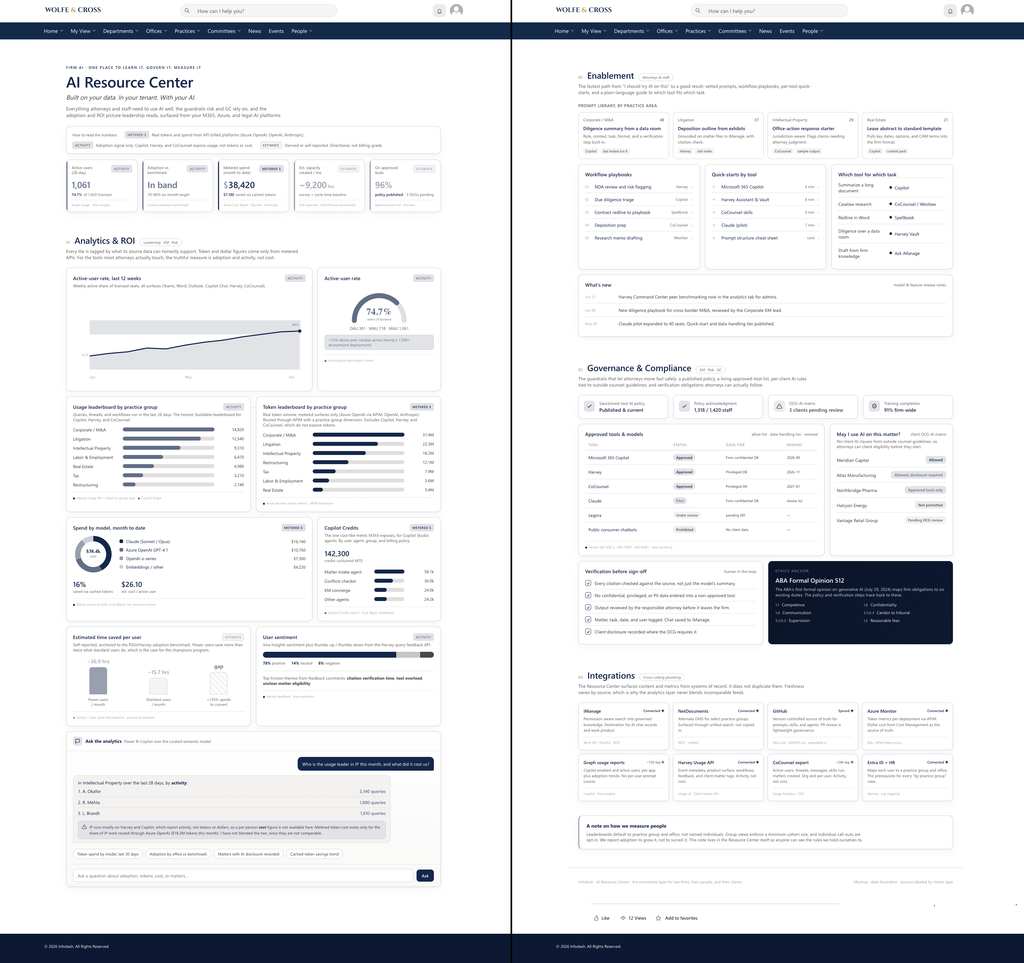
Business users need version control, approval workflows, publishing, and audit trails in an interface built for them. One governed place to learn the tools, check the policy, grab the approved playbook, and see what the program costs. Below is a mockup of what the presentation layer should include and what it might look like.
You may have noticed what I just described
A governed home for firm knowledge. Integrated with firm systems. Managed by business users, delivered in one branded interface.
That’s an intranet.
Full disclosure: I run a company that builds intranets and extranets for large law firms, so discount accordingly. I’ve had firm leaders tell me AI means they won’t need an intranet anymore, that a chat assistant will replace the whole thing. I’d argue the opposite, and I’d argue it even without skin in the game: the AI era is the strongest case anyone has made for this infrastructure in twenty years.
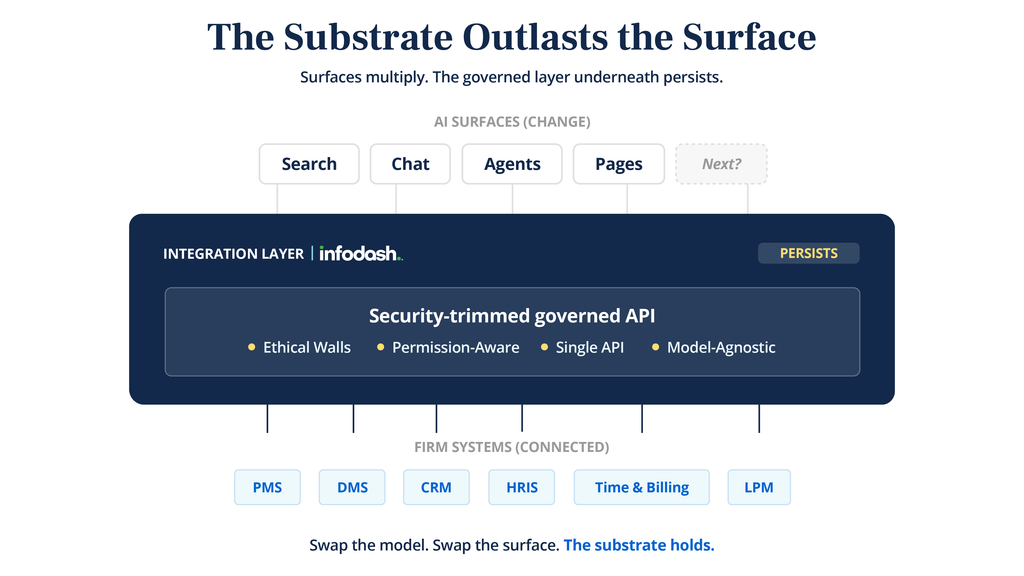
Start with what a modern law firm intranet actually is, because it isn’t a homepage with a phone list. It’s an integration layer with tentacles into every back-office system: practice management, document management, CRM, HRIS, time and billing, legal project management. That layer presents a security-trimmed, unified API that respects ethical wall boundaries. The portal is the visible part. The governed API underneath is the crown jewel, and it’s what makes a model-agnostic skill layer possible. Because the integration layer already sits between your people and every underlying system, it’s the natural abstraction point: swap the model underneath, and the skills, the data connections, and the governance all persist.
Your AI is only as good as your data foundation
The same layer solves AI’s biggest failure mode. Enterprise AI runs on retrieval: the model answers from what you feed it. Structured, permission-aware, integrated data in; useful answers out. Garbage in, garbage out, except now the garbage arrives with confident prose and citations.
The failure data is blunt about this. MIT’s NANDA study found 95% of enterprise gen AI pilots produce no measurable P&L impact, and the researchers pointed at flawed integration, not weak models. Gartner predicts organizations will abandon 60% of AI projects that aren’t supported by AI-ready data through 2026. A March 2026 Cloudera and Harvard Business Review study found only 7% of enterprises say their data is ready for AI. Those numbers describe a data foundation problem. The firms treating AI as a procurement decision keep hitting it. The firms treating it as an infrastructure decision don’t.
Interfaces aren’t going anywhere either
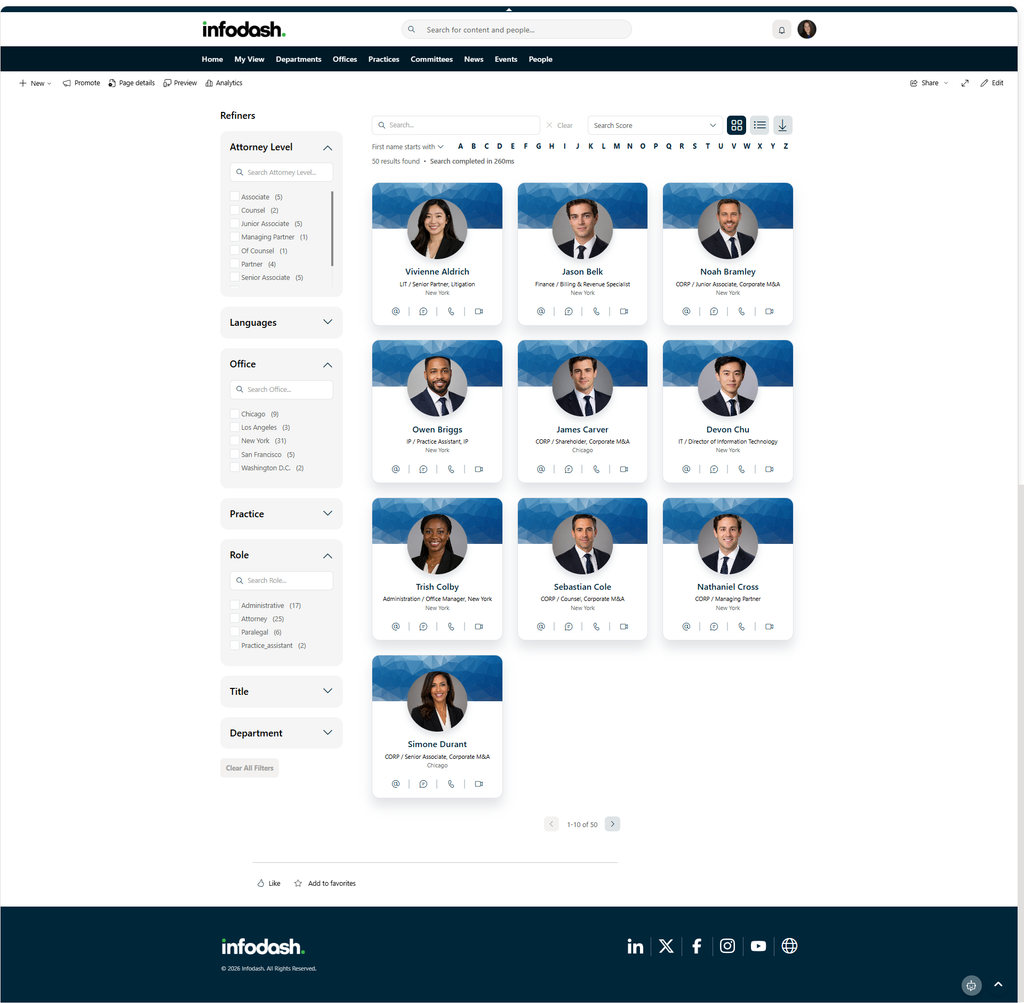
The second objection I hear is that chat makes structured interfaces obsolete. Try this search: an attorney with IP expertise, admitted in California, who has argued in the Southern District and speaks Spanish. Could you type that into a chatbot? Sure. But most users don’t know the firm tracks bar admissions, court appearances, and languages as structured data. A blank box hides your own data model from your people.
Additionally, firms still need to proactively deliver announcements, policy changes, risk alerts, training deadlines, events, and personalized communications by office, role, or practice. Pure chat interfaces can’t accommodate that. Hybrid interfaces which leverage chat AND the ability to peruse do. Faceted refiners show users what’s askable; Jakob Nielsen has estimated that about half the population isn’t articulate enough to get good results from a prompt alone. Chat and structured navigation are complements, not competitors.
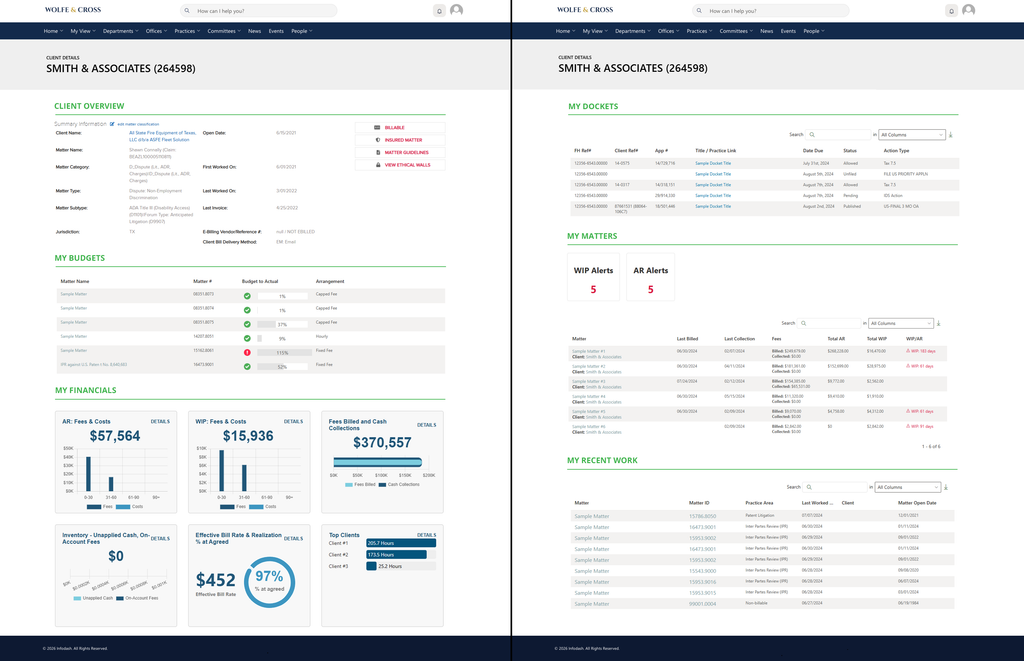
The same goes for consolidated pages. A matter page pulls client and matter details from the PMS, engagement letters and work product from the DMS, billing guidelines, ethical wall status, timekeepers, and budget versus actuals into one view. Harvard Business Review found workers toggle between applications about 1,200 times a day, losing roughly four hours a week to reorienting. Intranet pages are built to save humans that toll.
In legal, permissions aren’t optional
One more thing the substrate has to do: enforce walls. Ethical walls and the duty of confidentiality mean an AI must never surface content a user isn’t entitled to see. Not usually. Never. The Microsoft 365 Copilot rollouts taught this at scale: Copilot didn’t leak anything, it faithfully reflected years of sloppy permissions, and suddenly anyone could surface overshared content by asking a plain-language question. Microsoft’s own guidance now says to remediate oversharing before deploying. The fix lives at the data layer. A security-trimmed, wall-aware integration layer is the enforcement point, and it’s the difference between deploying AI confidently and deploying it while holding your breath.
The substrate outlasts the surface
The model leaderboard will flip again before year end. Surfaces will keep multiplying too: search, chat, agents, whatever ships next quarter. What persists underneath is the substrate: your integrated data, your security model, and a portable library of skills you own outright. Every new surface makes that substrate more valuable, not less.
So the right questions for your AI strategy aren’t about which model or platform to bet on. They’re these: Do we own our skill layer, or are we renting it back from a vendor? Is our data foundation ready to ground whatever model wins next quarter? Is it governed to the standard our ethics rules demand?
Firms that can answer yes will swap models the way they swap cloud regions, and barely notice the leaderboard changing. Firms that can’t will discover that their switching cost is everything they taught someone else’s platform.
Own the skill. Rent the model. And invest in the layer that makes both possible.
Subscribe for Updates